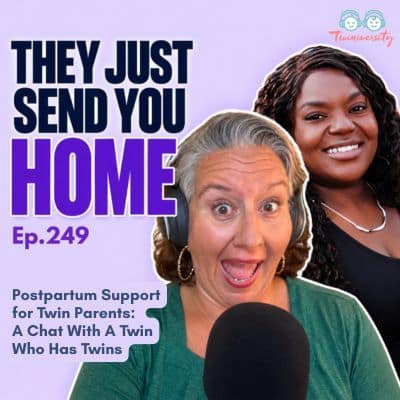

A twin mama who is a twin herself chats with Natalie Diaz about the ways in which the system fails to prepare parents for their postpartum experience.
In this episode of the Twiniversity Podcast, Natalie talks with Brittani Thorne–a twin herself who’s married to a twin and now has twins of her own.
Brittani is also a kidney transplant nurse and spends her working days making sure transplant patients know exactly how to protect the precious gift they have been given.
The irony is that when she was sent home from the hospital as a brand new mom of twins, that same preparation she provides her transplant patients wasn’t provided to her as a new parent.
Brittani’s episode is a reminder that there’s quite a gap in how we prepare parents for taking home their most precious gift. In those first days, weeks, and months, many of us are left wondering: “Shouldn’t somebody have told me this?”
Read on for the biggest takeaways from Brittani’s episode or watch the full episode here.
Takeaway 1: Twins raising twins doesn’t mean parenthood is standard operating procedure
Brittani is a twin whose twin brother lives in Arizona. They were adopted from Haiti in the ’80s and grew up in Minnesota.
Eventually, she married her now husband Jeremy, who is also a twin. Long story short, their parents and grandparents have already raised twins. So folks may feel that as a twin in a lineage of twins, they are better equipped to raise twins. After all, they can look at how they were raised and decide what to keep and what to redo.
Yet, Brittani shares that being a twin doesn’t automatically hand you the 101-level parenting basics.
If you just heard that second heartbeat for the first time, or you know it’s been two for a while, you need to read our twin pregnancy week by week timeline to help you learn what happens week by week with twins. Click here to learn more… and while you’re at it, check out our expecting twins classes and twin parent coaching services.
Takeaway 2: Brittani’s road to twins ran through loss and overwhelm
When it came to deciding to start their family, Brittani and Jeremy planned to wait until they felt settled. Then, they ultimately decided there’s never a “best” time and started trying. She got pregnant quickly. Sadly, that first baby was born at 21 weeks and didn’t survive.
Brittani had fibroids and had no idea. She had regular cycles and no obvious symptoms until that first ultrasound. So in February 2024, she went in for surgery and had 15 fibroids removed.
By September, she was pregnant again, and at the first ultrasound the doctor and the resident went quiet before telling her there were two. She laugh-cried. She felt overwhelmed when thinking about all the risk factors she was carrying: a second pregnancy, advanced maternal age, weight, being a Black woman in American maternity care, and the genetics of being a twin herself.
Takeaway 3: The discrepancy in care and preparation for new parents
Nat and Brittani discuss the glaring differences in how we prepare moms and parents versus how the medical world prepares folks for other conditions.
Brittani shares that on the pre-transplant side, coordinators walk patients through appointment after appointment: are you healthy enough for surgery, can you manage these medications, are you financially ready for this expensive new lifestyle.
Then on the post-transplant side (where Brittani works), she checks labs, watches for rejection and infection, coordinates between nephrologists and surgeons and families, and calls patients back in again and again. All because patients need to learn how to keep the gift of their precious kidney.
Prenatal care, by comparison, is a couple of labs, an ultrasound, “are you doing okay,” and out the door. A kidney that lasts 30 years is a triumph. You want your twins to make it to 100.

Have you taken your expecting twins class yet? We offer a great class on demand so you can take it on your own schedule! There are so many video modules covering everything from your twins’ baby registry to your first week at home with twins! Sign up today to get started before your twins arrive.
Takeaway 4: “Eat every two to three hours” is not a discharge plan
Nat, who works with new families as a lactation professional, says she is consistently alarmed by how few parents have actually read their discharge papers. So few genuinely understand what is supposed to happen once they get home with their little bundles.
When Nat asks families what the hospital told them about feeding, the answer is almost always some version of “every two to three hours.” And that’s it. Often, parents can’t remember being told much of anything.
What’s important to realize here is that this isn’t a character flaw or a personal problem. Postpartum parents are overwhelmed, physically wrecked, and sometimes discharged 24 hours after delivery. Then the follow-up call comes, someone asks how things are going, you say good, and the box is checked.
Takeaway 5: The NICU is the parent-education system nobody tells you to hope for
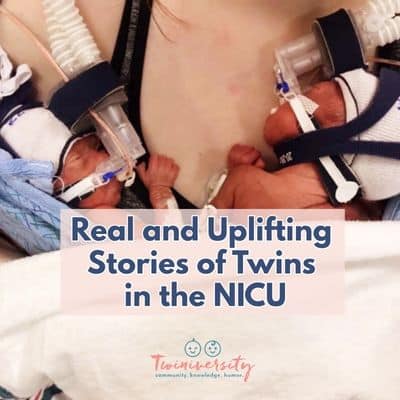
For Brittani, one twin spent 16 days in the NICU, and the other spent 21 days in the NICU. They were born at 36 weeks at almost six pounds, and Brittani spent four days in the hospital after a C-section with blood loss.
It was exhausting. Feed, pump, repeat, in a recliner. Since Brittani’s a nurse the overwhelm was different. She could read the monitor, which meant that seeing one of her babies re-intubated on the Angel Care app in the middle of the night, or the other with an IV in a tiny forehead, hit harder.
But the NICU also taught her family how to care for newborns: how to take a temperature, how to feed in positions that didn’t exist 40 years ago, how to sterilize parts, and how to build a supply.
Though it would be nice to miss the NICU altogether, the silver lining is that NICU nurses help to normalize what feels terrifying and they remind you to take care of yourself. If that type of hand-holding was available to parents outside of the NICU too, that would be the dream.
Takeaway 6: In a dream world, let there be “transitional” units
Nat shares her ideal vision of what postpartum care would entail if someone handed her the keys. After postpartum, before home, parents would get to stay in a transitional unit for around 5 days.
They’d get a room with a double bed so parenting partners can actually be together. And somebody checks on you more than once a day. The point of these transitional units wouldn’t be for clinical intervention but rather to have a safety net. A safe space to heal and learn the ropes of your new baby/babies.
As Nat puts it, if you feel safe and secure, you can be a better version of yourself. But if you are living in a permanently scared state, you simply can’t. Australia’s postnatal care is proof this isn’t a fantasy.
Takeaway 7: Postpartum support is the difference between surviving and healing
For Brittani, what actually helped the most postpartum was people. Her parents were at the door at 6:30 every morning, and her mom would take over so Brittani could go back to sleep in her own bed for a couple of hours.
Jeremy took nights and could go back to sleep when her parents arrived. Both sets of grandparents pitched in. The result is a sentence very few twin parents get to say: she never felt sleep-deprived.
This allowed Brittan to stay calm and heal. When it comes to postpartum care, it’s not even about having a formal parenting educations. What makes the biggest difference is feeling like somebody has your back.
Takeaway 8: Lean in, and maybe skip Dr. Google
Brittani’s advice to her friends is very low-tech: lean on people you know who have had kids, even if they had them 40, 50, or 60 years ago. Every human who has ever lived arrived the same way, so there is no shortage of people who have done this. Aunties, sisters, brothers, fathers, grandparents.
As a nurse, she encourages her patients not to lean on ChatGPT or Dr. Google for medical answers. Quality online resources do exist, so go the extra search bar mile to locate the resources that can best support you.
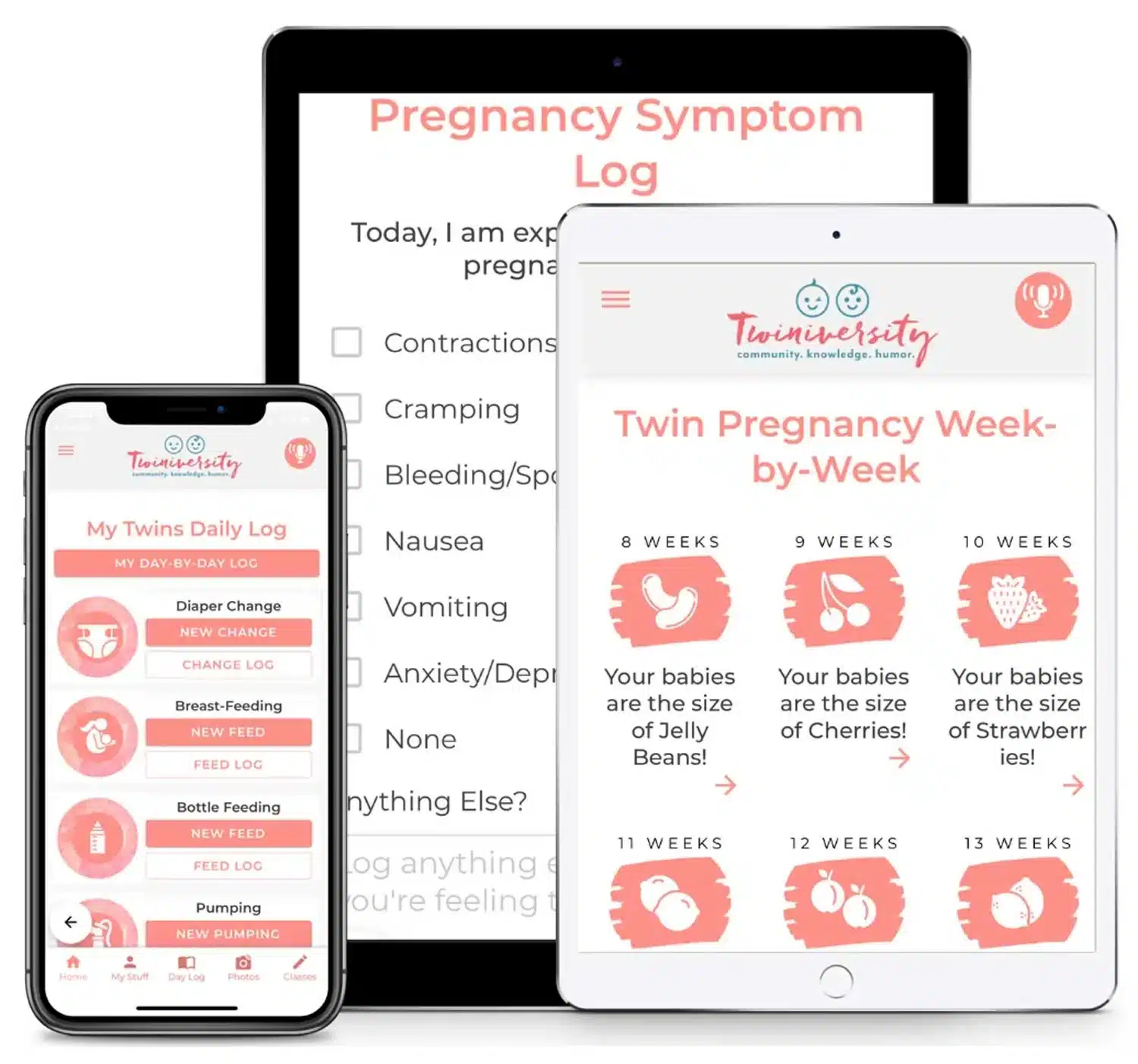
Brittani shares how she uses the Twiniversity app to check what’s normal for the week they are in. The internet can be a helpful supplement for information, but it pales in comparison to connecting with someone who has actually been through what you’re going through.
Want to hear the full episode between Nat and Brittani and their honest thoughts on parent preparation and postpartum support?
Watch this episode of the Twiniversity Podcast on YouTube!
Want to read through more Twiniversity podcast episodes? Check out these articles too:
- Lessons Learned from 24 Years of Raising Twin Boys
- Postpartum Anxiety is a Bitch
- The Expecting Twin Parent: What the Pregnancy Books Don’t Tell You