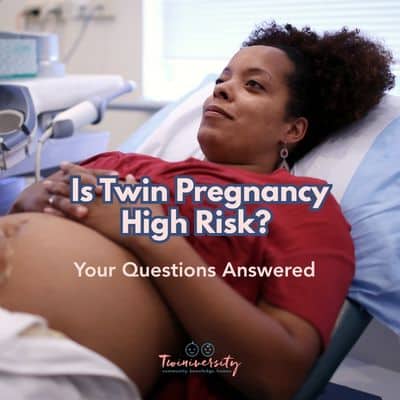

Newly expecting twin parents may find themselves wondering this common burning question: Is twin pregnancy high risk? If that’s on your mind, keep reading to get your questions answered.
Yes, according to almost all medical standards out there, twin pregnancies and higher order multiple pregnancies are considered high risk by default.
Keep in mind that this doesn’t mean that every twin pregnancy is guaranteed to experience extra complications. But from a medical standpoint, the pregnancy is labeled “high risk” for a few reasons.
Read on to learn the intricacies of why the medical world considers twin pregnancies to be “high risk.”
Does the type of twin pregnancy affect the risk?
Certain types of twin pregnancies carry more risks than others. The three types of twin pregnancies are:
- Monodichorionic monoamniotic twins (mo-mo twins or mono-mono twins)
- Monochorionic diamniotic twins (mo-di twins)
- Dichorionic diamniotic twins (di-di twins)
Of the three, mo-mo twins are the rarest and riskiest due to the twins sharing both a placenta and amniotic sac. Since they don’t have a membrane to separate them, there’s an increased risk for complications like cord entanglement. And twins that share a placenta (so, mo-mo and mo-di twins) are at risk for twin-to-twin transfusion syndrome (TTTS).

What are the main risks for twin pregnancies (for the babies)?
Aside from cord entanglement and TTTS, twin pregnancies carry an increased risk for:
- Premature birth
- Vanishing twin syndrome (or miscarriage)
- Congenital birth defects (like heart, lung, and gastrointestinal abnormalities)
- Placental abruption (the placenta detaches too early)
- Selective intrauterine growth restriction (sIUGR)
- Twin reversed arterial perfusion (TRAP)
What are the main risks for twin pregnancies (for the mother)?
- Cesarean delivery
- Gestational diabetes
- Hypertension
- Preeclampsia
- Anemia of pregnancy
- Postpartum hemorrhage
What else can make a twin pregnancy high risk?
Outside of your specific type of twin pregnancy, there are a few factors that can increase your chances of developing complications during your pregnancy.
Some of these include:
- Your overall health and any medical conditions you may have
- Your age
- Having a history or preterm birth or other pregnancy complications
- Lifestyle factors (like alcohol consumption, tobacco usage, etc.)
Know more: Common Complications of Twin Pregnancy
This sounds scary…can I have a normal twin pregnancy?
Definitely! The term “high risk” calls attention to the potential risks that are sometimes involved with twin pregnancies.
But just because you are pregnant with twins doesn’t mean you will have a run-in with one of these complications. There are plenty of examples of happy twin pregnancy stories and twin deliveries that aren’t riddled with extra challenges.
At the end of the day, the risks you face truly depend on your unique pregnancy and circumstances.
Here are some articles to read through to show you the other side of the twin pregnancy spectrum:

I Had A Normal Twin Pregnancy and Delivery

Feeling stressed about having a pregnancy that’s considered “high risk”? Check out these other twin pregnancy articles:
- Your Guide to Coping With Twin Pregnancy Complications
- Choosing Your Medical Team for Twin Pregnancy
- Where Should I Give Birth to Twins?
- What is an MFM Doctor, and Will I Need to See One for My Twin Pregnancy?
- Ask Your Doctor: 4 Questions When Expecting Twins
- Doctors Appointments in Twin Pregnancy: What to Expect
- Prenatal Care for Your Identical Twin Pregnancy
- What to Know About Your Birth Plan for Twins