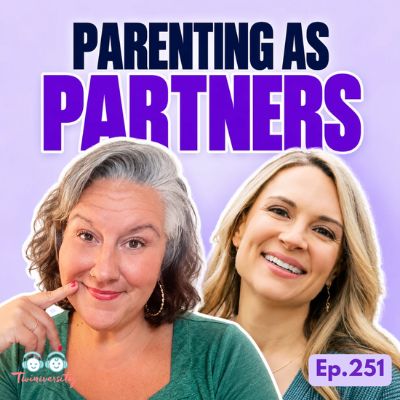

If you’ve been feeling like the division of parenting responsibilities has been a sore spot in your household, this podcast episode is for you!
Who do you feel like has been doing “more” at your house right now? And how long have you been keeping score?
In this episode of the Twiniversity Podcast, Natalie talks with Nicole Whitaker – a mom to twins and a singleton and a coach who helps career moms get out of survival mode.
Together they dig into one of the spiciest topics in any home with babies: the division of labor.
Nicole felt like she did everything “right” before kids. She and her husband talked about splitting things 50/50 long before they got engaged. Then her first baby arrived, and the grand plans felt like they went out the window.
By the time her twins came along, she was leading a team at work, carrying most of the load at home, and feeling so resentful that she didn’t like who she was becoming.
Watch the full episode here or keep reading for the biggest takeaways!
Takeaway 1: If you’re struggling with this, nothing is wrong with you
Nat opens with a hard truth: parents of twins face a higher divorce rate than average, and a lot of that tension comes back to who does what. The parent at home can quickly fall into a pattern of feeling like they do everything. The parent at work feels like being the breadwinner should earn more say.
Almost every couple struggles with this, especially after twins. And the initial struggling doesn’t mean your marriage is broken or that you’re doing it wrong. But it does mean you can’t sweep it under the rug.
As Nicole puts it, choose your hard: keep struggling through, or start having honest conversations.
Takeaway 2: Expect the system to change once babies arrive
Many couples think they have their “roles” figured out before kids. Even a chore chart can appear fair on paper. Then the twins come home and it all falls apart, and your partner may feel confused: “You knew who I was. I didn’t sign up for this.”
Nicole compares it to a reorg at work. When a company reorganizes, it’s messy and uncomfortable at first, but the change is needed so everyone can keep working toward the same goals. Your family just went through a reorg. The old system doesn’t fit anymore, and that’s okay.
Takeaway 3: The first conversation is with yourself
Before Nicole could talk with her husband, she had to face her own beliefs. She was a leader at work who had planned on a 50/50 split. But once her baby was born, her perfectionism and old patterns kicked in. She wanted to be the mom who got up every night and the one her kids always came to.
Eventually, she saw that this pattern was helping no one. She became so exhausted and couldn’t show up fully at work or at home. Her advice: take some space and ask yourself, “What do I really need right now? What do I really want?” Get clear on that with yourself first before you try to make your partner understand.

Takeaway 4: Use a soft startup and set a few ground rules
Nicole calls herself a fighter, not a flighter. She comes from a long line of loud Italian women, and her husband is very sensitive to tone. She used to let small things pile up, then unload on him over one comment while making dinner.
Her best tool now is the soft startup. Don’t start the talk in the middle of an emotional reaction or the dinner rush. Pick a time that works for your partner. For her husband, that means mornings or evenings. Once you’ve landed on the right moment, open gently: “Hey, something’s been on my mind I’d love to talk to you about. Is now a good time?”
Asking gives your partner room to say “not now,” and when they say yes, they’re committing to listen. Nicole and her husband also agreed on three rules for hot topics: keep it calm with no raised voices, seek to understand instead of only wanting to be understood, and remember the goal isn’t to win, it’s to reconcile.

Need some twin parent friends? Get the support you need with a Twiniversity Membership. Benefits include a monthly twin parent club meeting on Zoom, access to a private Facebook group just for twin parents, and a video library of twin parenting lessons. Visit Twiniversity.com/membership to join today!
Takeaway 5: Know your non-negotiables and where you can be flexible
Nicole asks couples to picture a circle. Inside are your non-negotiables, the things you won’t bend on. Outside are the areas where you could be flexible to meet your partner. When you both know (and say out loud) what’s inside and outside your circle, hard talks get a lot less defensive.
Nat is honest that “Sometimes it’s the flexible area that everything just sucks. I don’t wanna be flexible.” But for your partner to feel like a partner, they have to be able to make partner decisions too—even if it means the babies go to their first ballgame sooner than you’d like.
Takeaway 6: Resentment grows when you’re running on empty
Sometimes, the default partner (often the twin mom) tends to just get it done instead of waiting for their partner. But that only feeds the resentment. Nicole admits she waited until she hit an epic breakdown. In survival mode, she didn’t have even a few minutes to herself; her break was a two-minute cry in the shower.
She was short with her husband and then ashamed of herself for it. Her reminder: if you’re carrying most of the load with no space to care for yourself, of course you feel resentful. That makes sense, and it’s okay. The moment you notice it though is the moment change can start.

Takeaway 7: Start with 5 minutes for yourself
Nicole’s turning point was small. She locked herself in her closet for five minutes each night – not to meditate, not to get anything done, just to sit in silence. That’s when she started to remember, “Oh yeah, I’m a person too. I have needs too.”
Nat’s mantra is: you are not relaxing, you are recovering. You wouldn’t expect someone to go back to work the day after surgery. Parenting twins is hard work, physically and emotionally, and making a little space for yourself every day can’t be optional.
Takeaway 8: Your partner is a partner, not a helper
Nicole recommends the book Fair Play by Eve Rodsky to anyone struggling with the division of labor. One big idea from it is this: your partner isn’t a helper. Too often, moms or the default parent do all the planning for a birthday party and just send their partner to pick up the cake.
That’s handing off a chore, not sharing the load. Real ownership means your partner owns the whole thing—the planning, the mental load, and the doing. If the snacks aren’t a big deal to you, let them pick the snacks, even if it’s a Dorito dip you don’t love. Save your energy for the parts you truly care about.

Takeaway 9: Let go of how it gets done
Nat shares a story from when her twins were little. Her husband sent her out for a break, and she came home to find the twins eating cereal out of bowls on the kitchen floor like puppies. All she could see was spilled milk, germs, and the dog’s paws. All he saw was kids having fun.
Today her twins are 21, and they still remember that day with pure joy. “Little kids, little problems.” Nicole adds that when parenting styles clash, couples can agree on a few shared non-negotiables and let the rest live in the flexible zone. It also helps to zoom out and ask: a few years from now, what will really matter?
Takeaway 10: Skip the 50/50 scoreboard
Trying to keep things exactly 50/50 can turn into tit for tat. “You got five minutes, so I get five minutes.” Nicole points to Brené Brown’s idea that marriage is never 50/50 on any given day.
Some days it’s 80/20 or 70/30, and what matters is meeting each other where you are. And when one partner makes a call that shakes up the routine, like a late outing with the babies, Nicole suggests they own the fallout too, including the rough bedtime that follows.
Feel this episode about twin parenting to your core?
Twin parenting isn’t just about the babies. It’s also about the people raising them. You’ll spend years together raising these little humans to send out into the world, and one day it will be just the two of you again.
It’s not too late to have the conversations and to reconfigure a parenting partner relationship that feels good for both of you. You’re not alone!
Book a free 1:1 coaching call with Nicole at nicolewhitaker.com or join the Twiniversity team inside of the Twiniversity membership which includes a monthly live support call.
Want to listen to more Twiniversity Podcast episodes or read about twin parenting topics? Check these articles and episodes out too!
- Struggles of Being the Default Parent With Twins + How to Make it Better
- When Your Twins Favor One Parent Over the Other
- Life With Twins: The Early Years Ranked by Difficulty Level
- How to Be a Supportive Partner: Twins Edition
- Getting on the Same Team With Conflicting Parenting Styles